
December 30, 2025 by Pat Thomas
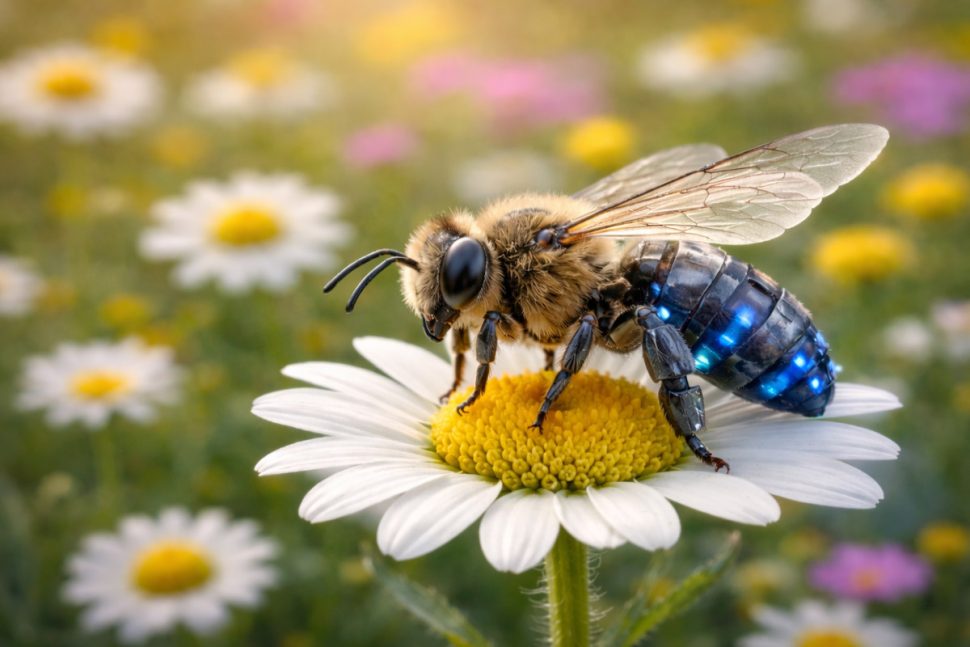
Imagine a honey bee carrying a genetically engineered microbe landing on a wildflower. Now imagine that flower belongs to a species whose genome has been edited using CRISPR. Both interventions were designed to stay within their managed systems – the beehive and the field – yet both can move, mix and evolve in ways no regulator or ‘company or ‘innovator’ can fully predict or control.
The image of the bee and the flower is more than a metaphor – it captures the profound ecological truth that life is built on connection and exchange. Every time a bee lands on a flower, genes, microbes and chemical signals move between species in a choreography billions of years old. It is a relationship that transcends the boundaries we draw between wild and managed nature.
When we introduce genetic engineering into that relationship – whether by altering the bee, the flower, or the microbes that live within them – we are not operating on isolated systems but intervening in this shared and interdependent web of life. The symbolism matters because it shows, in the simplest possible way, why the idea of control is misplaced: the very act of contact is an act of transformation.
Across agriculture, conservation and even climate policy, we are witnessing a new surge of confidence in genetic engineering as a tool to manage nature – from crops edited for drought resistance, to microbes designed to boost soil health, to insects genetically reprogrammed to fight disease. These technologies are promoted as precise, safe and controllable.
As governments, including the UK and EU, move to deregulate gene-edited organisms and as synthetic biology moves from lab to field, it becomes vital to ask: How controllable are these technologies, really?
This year we supported EU colleagues who tabled a motion at the 2025 IUCN World Conservation Congress for a moratorium calling for a moratorium on the release of genetically engineered wild species. The motion, rooted in the precautionary principle, was defeated by the narrowest of margins – just one vote.
The gathering focus on using genetic engineering as a conservation tool has led us to consider the overlooked issue of interactions between managed and wild organisms.
Honey bees are one of the most current and compelling examples. But a 2025 literature review and analysis by the Netherlands’ Commission on Genetic Modification (COGEM) further develops the picture. It shows that the same dynamics and risks also play out in plants and that “genomic techniques” such as gene editing raise specific risks that are not addressed by current regulations.
Together, these examples reveal a stark reality: the containment of living genetically engineered organisms is largely a myth and the illusion of control may be one of the biggest environmental blind spots of our time.
Honey bees (Apis mellifera) are often treated as symbols of nature’s resilience, yet they are one of the world’s most intensively managed livestock species. Their hives overlap with thousands of wild bee species and other pollinators, exchanging microbes, pathogens including viruses via shared flowers.
In recent years, scientists have proposed using ‘synthetic biology’ (genetic engineering) to engineer bees’ gut bacteria – for example by inserting genes that produce compounds toxic to parasites like Varroa mite. The idea is to make colonies more robust.
But bees don’t stay in place. They forage across farmland, gardens and conservation areas, carrying these microbes with them. Studies show that flowers act as microbial hubs linking bee and plant microbiomes. Any engineered organism introduced into this system could spread well beyond managed hives.
The possibility of engineering containment tools such as genetic “kill switches” may look convincing on paper, but these biocontainment tools are not fool-proof. Once self-replicating microbes are released, they cannot be recalled. Liability and ecological redress become nearly impossible.
The flowers that bees rely on can also be genetically modified using conventional tools or newer ones like CRISPR. But, again, the picture is not straightforward.
The COGEM review for example looked at “introgression” – the movement of genes from cultivated plants into their wild relatives – and found a clear pattern. Across 25 crop species including maize, beet, rapeseed and rice, gene flow between crops and wild relatives is common, regardless of whether the crop is conventionally bred, transgenic, or gene-edited.
Pollen travels. Seeds escape. Hybrids form and backcross with wild relatives, transferring novel traits into wild populations. The report found that introgression is widespread and essentially impossible to prevent and acknowledged previous research suggesting at least half of temperate-region crops can interbreed with one or more wild relatives.
These genetic exchanges can result in adaptive introgression (where engineered traits help wild plants become invasive) or genetic assimilation (where wild populations lose distinctiveness). Either way, the outcomes are unpredictable and potentially irreversible.
COGEM’s conclusion was simple: gene flow cannot be prevented and is difficult to monitor. Measures to contain it only work partly and only for a little while.
The parallels between engineered bees and gene-edited plants are striking. In both, human interventions collide with ecological realities. Nature operates through open systems of exchange – pollen, microbes, soil organisms and symbiotic networks that cross species and landscapes.
Yet regulation assumes that genetic engineering can be neatly categorised and confined under terms like “contained use” or “deliberate release.” In the real world, these distinctions break down. A bee carrying an engineered microbe or a plant passing edited genes to a wild cousin quickly moves beyond any fence, field or rule meant to contain it.
In addition, COGEM found that engineered traits may spread faster or farther, especially when controlled by only a few genes.
For bee microbiome engineering, even the risk-assessment framework is undefined. The EFSA public consultation on microorganisms obtained through synthetic biology highlighted just how complex these systems are. It noted that engineered microbes can interact with natural ecosystems and existing microbial communities in unpredictable ways, especially once they are outside controlled settings.
These concerns were reflected in the 2020 EFSA SynBioM guidance, which recommended that any synthetic microorganisms intended for an open environment should be evaluated on a case-by-case basis. These are, of course, fine words on paper. But too often we have seen that in practice, “case-by-case” becomes code for careless deregulation.
These brief examples reveal deeper weaknesses in the current regulatory approach. Our current genetic engineering laws were created in an era of laboratories and fenced fields, not self-spreading organisms. Engineered bees fall between animal-health, pesticide and biotech rules. Gene-edited crops and animals are being exempted from GMO regulation altogether in some countries.
In the UK, for example, whist the Genetic Technology Act 2023 purports to allow for case-by-case evaluation, the definition of “precision bred” plants and animals is so broad that almost any plant or vertebrate animal (other than humans) could be genetically altered and released outdoors without independent assessment or monitoring. The Act also gives the government the power to expand this range of organisms at any time, without parliamentary scrutiny or public consultation and the exemptions granted in the Act mean that any of these could be released for experimental purposes into the English countryside on the basis of developer self-certification, with no oversight or monitoring.
International frameworks exist – the Convention on Biological Diversity, encompassing the Cartagena Protocol on Biosafety and the Nagoya Protocol, for example provide for the conservation of biological diversity, the sustainable use of its components and the fair and equitable sharing of benefits arising from the use of genetic resources. The Aarhus Convention including its recently ratified ‘GMO Amendment’ emphasises precaution, transparency and public participation. But enforcement is weak and major biotech-exporting countries such as the United States are not parties to these agreements.
Without clear accountability, the burden of monitoring and potential remediation falls on non-governmental organisations (NGOs) and the public. Developers are never held to account.
Engineering bees or crops to cope with human-induced pressures like pesticides or climate change may seem efficient, but it treats symptoms rather than causes. It also assumes that technology can outperform, or out-smart ecological complexity.
A genuinely sustainable approach would instead focus on restoring habitats, reducing chemical exposure and supporting biodiversity – solutions that strengthen resilience without rewriting genomes.
Both the bee and crop examples remind us that once engineered genes or microbes enter wild populations, there is no recall button. The question is not whether escape will happen, but what kind of world we are willing to release them into.
In the age of engineered life, innovation must be judged not just by what it can do, but by what it contains and what it is contained within. Every genome we alter exists within a web of others. When we edit one thread, the whole web moves.

From A Bigger Conversation
As the EU revises rules for gene-engineered plants, debate centres on safety, traceability…
From A Bigger Conversation
As farming knowledge shifts from fields to algorithms, digital tools reshape how farmers s…
From A Bigger Conversation
Genetic engineering cannot be contained in living systems. From bees to crops, engineered…
From A Bigger Conversation
Synthetic human genomes are being developed faster than society can govern them. Good inte…

Share this page
share using:
Or copy and paste this page address:
https://beyond-gm.org/editing-nature-examining-the-illusion-of-control/